Puro Junke: How Saturday Morning Yard Sales Became a Theology
There's a specific kind of Saturday morning that lives in my body like a memory I never have to try to recall. The kind that just shows up — in the smell of a thrift store, in the sight of a folding table covered in someone else's life, in the quiet thrill of spotting something nobody else noticed.
It starts before the sun is all the way up. My parents piling us into the car — me and my three siblings, all of us in various states of still asleep. We grew up in Whittier, and if you know, you know: Whittier has the best yard sales. I'm not even a little biased. It's just true.
My siblings did not agree.
By the third or fourth stop of the morning, the complaints would start. By the eighth or ninth, someone would groan the moment we slowed down. And by the tenth — and there was always a tenth — my brothers and sisters had developed a full ritual. The moment we pulled up to another driveway lined with folding tables and plastic bins, they would yell out:
"Puro junke!"
Pure junk. Spanglish. Delivered with the energy of kids who had been dragged to one too many strangers' front lawns before 9am.
But here's the thing — I never felt that way. Not once.
I was the one already out of the car before my dad put it in park. I was the one scanning the tables, moving slow, looking for the thing that didn't belong. The piece of furniture that was too good to be here. The jacket folded at the bottom of a bin that nobody thought to shake out. The ceramic bowl that someone's grandmother made by hand and someone's grandchild couldn't find space for anymore.
That's the part that always got me. The stories.
If you slow down long enough to talk to the people selling — especially the elders — they'll tell you everything. Where something came from. Who made it. What it meant. I've stood in driveways in Whittier listening to people describe a piece of handmade furniture like they were reading from a family Bible. And then they'd sell it to me for three dollars.
I used to wrestle with that. How can you let this go so easily? How is this worth so little to you?
But I started to understand something over the years. They weren't saying it had no value. They were saying they were done carrying it. They had released their attachment. And in letting it go, they opened the door for someone like me to come along and see it differently. To pick it up. To bring it home. To love it back to life.
That's the whole theology of the Redeemed collection right there.
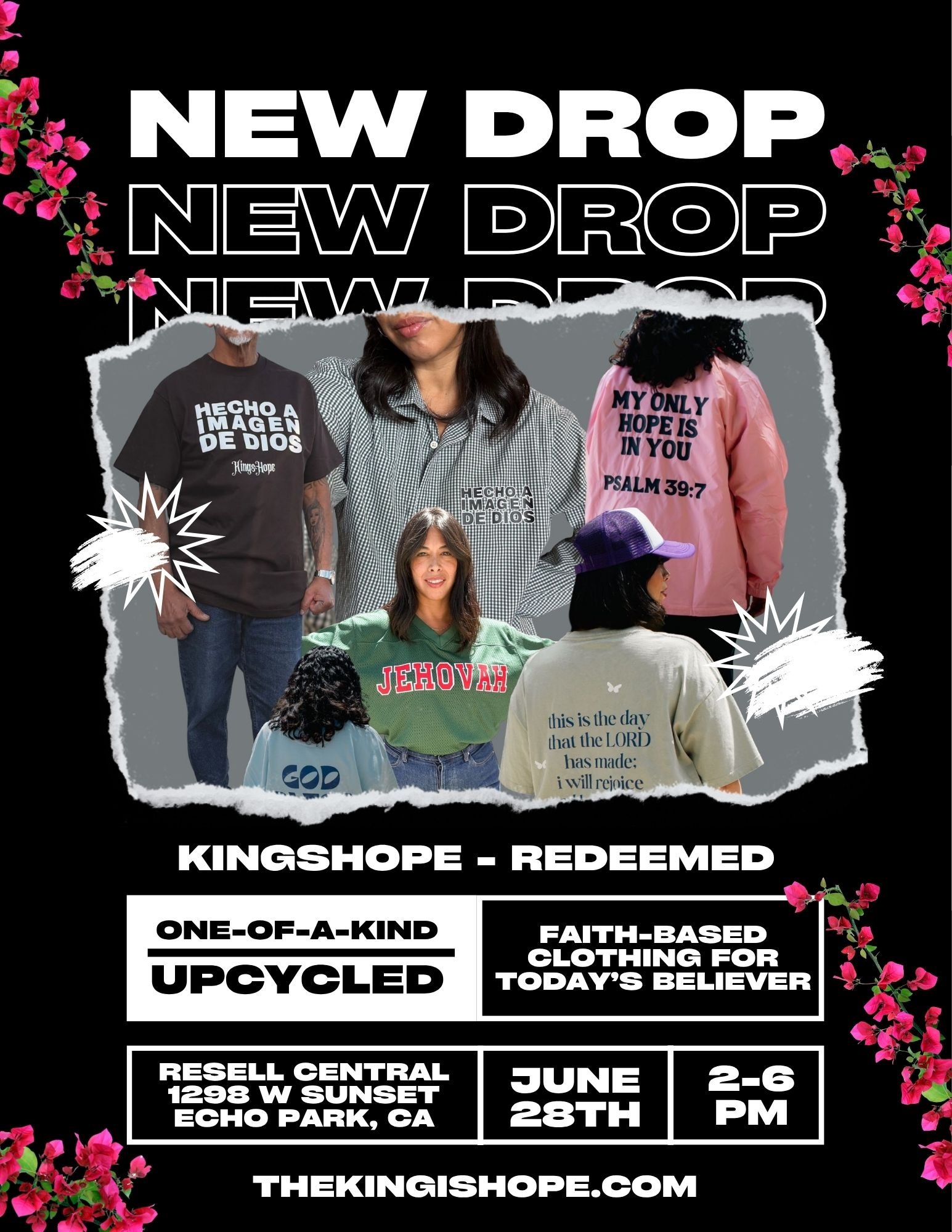
Every piece in Redeemed started at a thrift store or a yard sale. A men's button-up that hung on a rack for months. A jacket someone decided they were done with. Jeans that had a whole life before I ever touched them. Items that the world looked at and said — disposable. Not worth holding onto.
And I came along and saw something else entirely.
I pressed a declaration onto the back of a thrifted shirt. I put scripture on a jacket that someone gave away for two dollars. I took something the world passed over and I said — no. This has a story. This has value. This is worth something.
That is not just a design philosophy. That is the gospel.
Because the enemy has been lying to us since the beginning. Telling us we are disposable. That we are too far gone, too broken, too used up to be worth anything. That we belong in the bin. That nobody is coming for us.
But God.
He is the original thrifter. The one who shows up to the yard sale of our lives — after the world has priced us low, after we've been folded up and set out on a table — and He sees us completely differently. He picks us up. He breathes new life into us. He puts His name on us.
We are not junk. We are not disposable. We are not done.
We are REDEEMED.
The Redeemed collection drops Sunday, June 28th, 2–6pm at Resell Central (1298 W Sunset Blvd, Echo Park). Every piece is one of a kind. Every piece has a story. Come find fellowship, come find your piece.